Best Month For A Punta Cana Boat Trip
Punta Cana sells boat trips year round, and most weeks deliver. What actually changes through the calendar is rain, seaweed and the small chance a tropical system reshuffles your plans.
Short answer
The calmest window for a Punta Cana boat trip is typically December through April, the driest stretch of the year with the lowest hurricane risk. March is the driest month on record at about 53 mm of rain and October the wettest at about 142 mm. Sargassum eases after the summer peak, and shared party boats run from $49 per person in every month.
Boat operators in Punta Cana do not close for winter, because there is no winter here. The shared catamarans, the adults-only hip hop boats and the Saona Island day trips run the same routes in February as in August, and the sea stays warm enough to swim every month of the year. What shifts is the weather around the boats: how much rain falls, whether sargassum weed is drifting onto the east-facing beaches of Bavaro and Macao, and how likely a tropical wave is to force a reschedule between June and November. Because Saona sails year-round, our Saona Island trip verdict can help you decide if that full-day crossing deserves a spot on your itinerary.
The short version, and the honest one: there is no bad month to be on a boat here, only months with more variables. December through April is the classic high-season window, dry and busy and priced accordingly. Summer brings the heaviest seaweed risk on Atlantic-facing sand but perfectly normal sailing on the water itself, and late autumn, the wettest stretch of the calendar, often delivers half-empty boats and soft light on the same Caribbean Sea. A reader timing their trip is really deciding whether and when to book, and this page works through that decision month by month, using the climate record and the verified season facts rather than brochure optimism. For the full picture of what actually sails, the tour picker on Punta Cana Party Boats lists every bookable boat with its live dates.
When Is The Best Time To Visit Punta Cana For A Boat Trip?
The best overall window is December through April, when Punta Cana records its lowest monthly rainfall, roughly 53 to 89 mm, and the Atlantic hurricane season has closed. Within that window, February and March are the driest months and carry the smallest chance of a washed-out boat day. Prices and crowds peak in the same stretch, so shoulder months trade a little weather certainty for calmer decks.
That is the headline, but the month-by-month picture deserves a table, because the rain curve here is gentle rather than dramatic. Punta Cana averages between about 53 mm and 142 mm of rain a month across the year, which means even the wettest month averages less than a tropical monsoon climate would deliver in a week. Most of it falls in short afternoon bursts, not all-day soakers, and boats sail in rain that would close a zip-line course.
| Month | Typical rain (mm) | What it means for a boat day |
|---|---|---|
| January | 67 | Dry, busy, reliable sailing weather |
| February | 55 | Second driest month, peak season crowds |
| March | 53 | Dry, warm, high season continues |
| April | 73 | Last comfortably dry month before the shift |
| May | 131 | Rain builds, sargassum season approaching its peak |
| June | 112 | Hurricane season opens, still plenty of sailing days |
| July | 92 | A drier pocket inside the wet half of the year |
| August | 101 | Peak sargassum months on Atlantic-facing beaches |
| September | 109 | Storm season at its statistical height, quiet decks |
| October | 142 | Wettest month, lowest crowds, soft prices |
| November | 119 | Rains taper, hurricane season closes on the 30th |
| December | 89 | Shoulder month, drying out, demand climbing |

Two things follow from that curve. First, the difference between the driest and wettest month is real but not trip-ending, roughly a hundred millimeters spread across a whole month. Second, rain in Punta Cana is not evenly spread through the day. Convection builds over the hot interior and pushes toward the coast in the afternoon, which is one reason morning departures and sunset departures are the two formats most operators lean on. The luxury sunset party boat from Renny Travel, from $75 per person with an open bar of national drinks and 4.4 from 12 reviews, is built exactly around that late-day slot, departing Playa Bibijagua when the afternoon build-up has usually already cleared. If you want to go deeper on the seaweed variable specifically, the guide to sargassum and sea conditions for boat trips breaks that season down on its own page.
What Is Hurricane Season In Punta Cana?
The Atlantic hurricane season runs from 1 June to 30 November, and Punta Cana sits inside that risk window every year. Direct hurricane strikes on the Dominican Republic's east coast are historically uncommon, and the practical effect on most trips is a rescheduled boat day rather than a ruined week. Booking tours with free cancellation, as most of the trips below do, removes most of the downside. Once your dates clear the storm window, the sunset reality on this coast will help you pick the right evening cruise.
The season dates are not folklore, they come from the National Hurricane Center's official climatology, which defines the Atlantic basin season as 1 June through 30 November (NOAA National Hurricane Center). Within that window, activity statistically concentrates from mid-August to late October, with the historical peak around 10 September. The early and late edges of the season, June and November, see far fewer systems.
What a named storm actually does to a Punta Cana vacation depends entirely on track and timing. A hurricane passing hundreds of miles north can still push a swell and a windy day onto Bavaro, and operators cancel or reschedule when the crew judges conditions unsafe. Whether a boat sails is always the operator's call under the listing's own cancellation terms, never a promise. The consistent norm across operator policies is a full refund or a new date when the operator cancels for weather, and no refund for guest no-shows, so the reader's protection is choosing bookable-with-free-cancellation listings in the first place. If a stormy stretch scraps your sailing day, the things to do in Punta Cana guide lays out beach, nightlife, and inland options to fill the rest of your week.
The tours below make that easy. Nearly every shared boat on this site lists free cancellation, including the four-hour catamaran party cruise with unlimited drinks from KayG Travel, from $64 per person and rated 4.0 from 236 reviews, which runs its Bavaro coastal route in every month of the calendar. Storm season should shape your booking habits, not your destination. For a fuller treatment of the topic, see hurricane season and Punta Cana boat tours.
A reasonable question is whether to avoid September and October outright. The honest answer is that these are the wettest months and the statistical heart of storm season, and they are also when boats carry the fewest passengers and hotels charge the least. A traveler with fixed dates, travel insurance and a flexible arrival buffer can do very well here. A traveler with one precious week and no slack should weight toward the dry half of the year.
When Does Sargassum Hit Bavaro And Punta Cana Beaches?
Sargassum season on Punta Cana's Atlantic-facing coast typically runs from April or May through October, with accumulation peaking between May and August. The seaweed affects the beach experience far more than the boat experience, since catamarans and party boats sail out to reefs, sandbars and natural pools in open water. By late season, monitoring shows the bloom shrinking in almost every region.
Sargassum is the brown seaweed that has reshaped Caribbean beach expectations over the past decade. It arrives on east-facing shores, which in this area means the exposed Atlantic stretch from Macao through Bavaro and up to Uvero Alto, while the more sheltered Caribbean-side waters toward Bayahibe and Saona Island generally see far less of it. Wind direction shifts it onto or off a given beach within hours, which is why a morning report and an afternoon reality on the same stretch of sand can disagree.
The scientific picture is tracked by the University of South Florida's Optical Oceanography Lab, whose bulletin states that in September 2026 sargassum amounts continued to decline in almost every region but remained relatively high compared with previous years for the same month (USF Sargassum Watch System). Translated into trip planning: the heavy landings happen in the May-to-August band, autumn is a tapering tail, and by the December-to-April window the issue is largely off the table.
| Season | Sargassum on Bavaro and Macao beaches | Effect on the boat itself |
|---|---|---|
| December to April | Minimal to none, the low season for the bloom | Snorkel stops and sandbars run normally |
| May to June | Landings build toward the summer peak | Boats still sail, operators favor clear-water stops |
| July to August | Peak accumulation on Atlantic-facing sand | Open-water stops and natural pools stay usable |
| September to October | Declining amounts, patchy arrival by wind | Normal itineraries, fewer guests on board |
| November | Transition month, bloom shrinking | Normal itineraries |
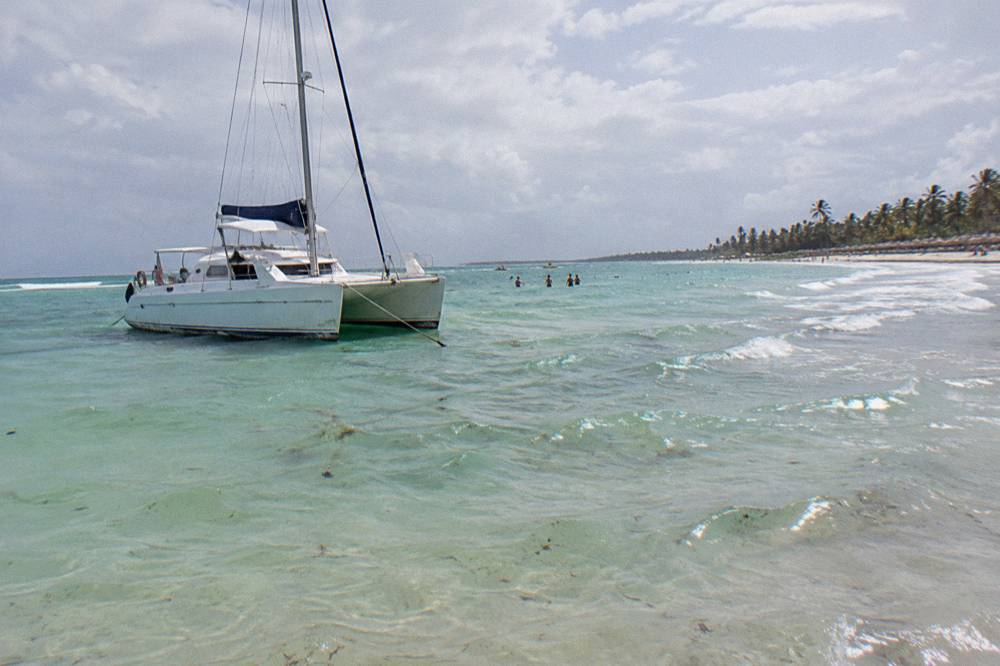
Here is the point that surprises visitors who have read alarming beach coverage: the seaweed sits on the beach, not on the itinerary. A party catamaran leaving Bavaro spends its day at a reef snorkel stop, waist-deep sandbar or the natural pool, all reached in open water where sargassum is either absent or a passing patch. Operators note that their routes reach open water or specific stops where beach weed does not directly touch the experience. The Saona trips compound that advantage by crossing to the Caribbean side, where Bayahibe and the island sit comparatively shielded. So a July visitor whose hotel beach looks rough in the morning can still have a perfectly clear afternoon at the natural pool on the multilingual hip hop party boat from Sunny Adventures, from $58.50 per person and 4.8 from 775 reviews, with its open bar of national drinks and sandbar stop. If you're wondering why so many boats make that crossing in the first place, the story behind Saona Island's fame covers the starfish pool, the beaches, and the movies that put the island on the map.
The one honest caveat is the beach-club style departure. A handful of listings, like the adults-only open-bar party boat from Dreams Come True Tours, from $49 per person and 4.9 from 145 reviews, gather guests at a shoreline point before boarding, and a heavy sargassum morning can make that first half hour less postcard-perfect than the three hours that follow. It is cosmetic, not a cancellation.
Which Months Have The Least Rain In Punta Cana?
March is the driest month, averaging about 53 mm of rain, followed by February at about 55 mm and January at 67 mm. December through April forms the dry half of the year, with every month at or under about 90 mm. July, at about 92 mm, is the driest month inside the wet half and a legitimate value pick.
Rain in Punta Cana behaves differently from rain in a temperate climate. The totals above come from long-term climate tables, and they average out many short, heavy afternoon showers rather than long gray spells. A "rainy" day here commonly means an hour of downpour bracketed by sun, which a three-hour boat schedule can sail around, especially on morning or sunset departures. What actually cancels boats is wind and sea state, not rainfall itself, and the operator reads that on the day.
That July figure deserves more attention than it gets. It sits inside hurricane season, yes, but early season is historically quiet, and it comes with shoulder-season pricing and genuinely dry statistics. The trade-off is sargassum near its summer peak on Atlantic-facing beaches, with the beach-versus-boat distinction from the previous section doing the work. For travelers who cannot travel in the February-to-April window, July is the pragmatic runner-up.
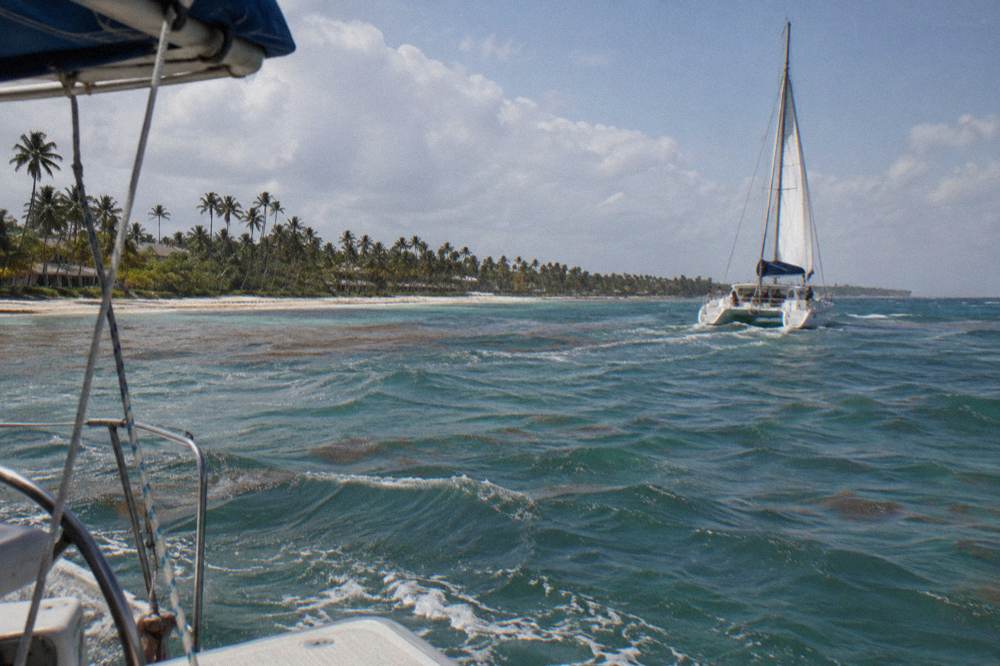
The rain calendar also maps neatly onto which boat format suits the month. In the dry, packed high season, shared boats fill and the water is at its most social. In the wetter shoulder months, small-group formats and private charters protect the experience against both weather wobble and thin crowds.
| Format | Best-fit months | Why the season suits it |
|---|---|---|
| Shared party catamaran | December to April | Reliable weather, full decks, maximum atmosphere |
| Sunset cruise | Year round | Late-day slot dodges afternoon build-up in every month |
| Small-group catamaran | May to November | Calmer decks in shoulder season, flexible stops |
| Saona full-day trip | November to August | Caribbean side is sheltered from Atlantic weed and swell |
| Private charter | October and November | Lowest demand, same itinerary, negotiable dates |
The small-group row of that table has a concrete anchor among the tours below: the Happy Fish Catamarans trip capped at 27 guests, from $83.66 per person with a 4.8 rating across 465 reviews, and inclusions such as a stand-up paddleboard, restroom on board and hotel pickup. In a quieter month, a boat that size feels close to private at a shared price.
Should You Book A Sunset Boat Or A Saona Day Trip By Season?
Book the sunset boat in any month, because its three-hour late-afternoon window is the most weather-resistant format on the coast. Book the Saona full-day trip between roughly November and August, when the sheltered Caribbean side avoids the worst of both Atlantic sargassum and early-season swell, and give it the widest schedule margin you can in September and October.
The two formats fail differently, and that is the whole argument. A sunset cruise is a short commitment placed at the hour when convection is usually collapsing, so its weather exposure is minimal and its worst case is a rescheduled evening. A Saona day is a nine-to-eleven-hour door-to-door expedition involving road transfer to Bayahibe, a speedboat crossing, beach time, buffet lunch and usually a catamaran party return, so it has more moving parts and benefits from a trip window with slack in it.
The Saona benchmark here is the catamaran and speedboat day from Caribbean Route Punta Cana, from $71.20 per person with buffet lunch and open bar included, and at 4.4 from 4,767 reviews it stands as the most reviewed trip on the entire site. Its itinerary, a 30-minute natural swimming pool stop and around three hours on Saona, describes exactly the sheltered Caribbean-side day that the sargassum calendar barely touches. The dining and beach time mean it rewards stable weather more than a bar-hopping catamaran does.
Sunset products, meanwhile, split into two flavors worth naming. The SeaPro Divers party boat cruise, from $89 per person and 4.7 from 174 reviews, runs three hours with a sandbar stop and snorkeling gear, capped at 50 guests. The luxury sunset party boat covered earlier covers the same late-day window at a lower entry price with open bar and snacks. Both run year round; the choice is crowd size and deck style, not season.
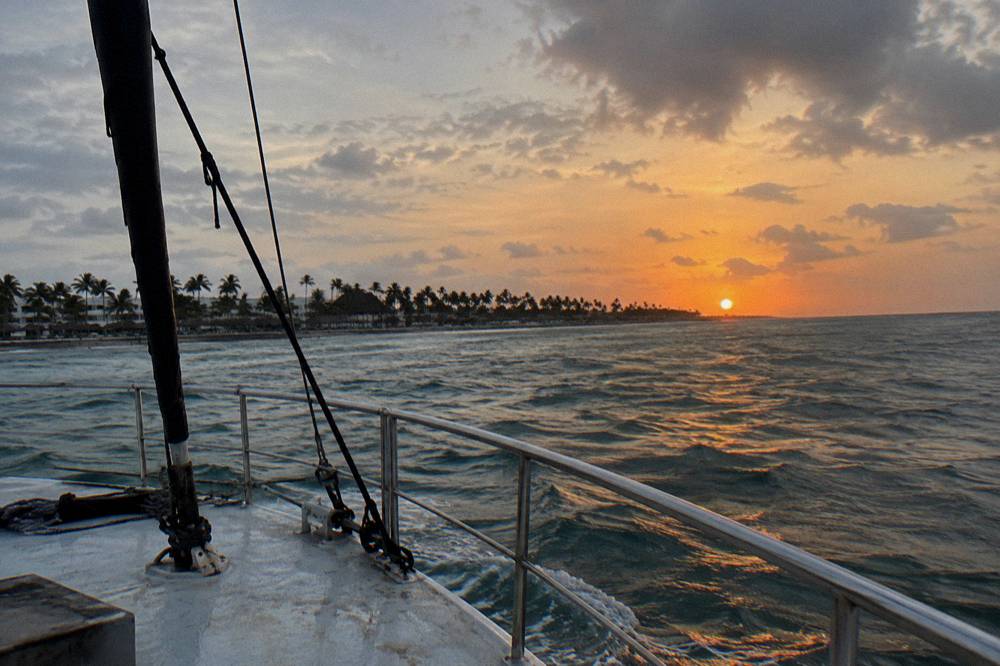
One seasonal note specific to the sunset format: December and January deliver the shortest days of the year here, while June and July stretch daylight to over thirteen hours. No sunset departure needs the extra light, but early-winter departures do sail in darkness for part of the trip, which many guests find is half the charm.
What Time Of Day Works Best For A Boat Trip From Bavaro?
Morning and late afternoon are the two most reliable windows, and listings concentrate there for that reason. Morning carries the flattest sea and the clearest inshore water, while the sunset slot sails after the typical afternoon shower has already passed. Midday departures exist, mostly on full-day Saona itineraries where the schedule fills the whole day anyway.
The daily rhythm of Caribbean coastal weather is consistent enough to plan around. Nights and mornings are usually calm, heating through midday builds clouds over the interior, and the afternoon delivers the shower or squall that clears toward evening. A boat that boards at 9 or 10 a.m. is usually back before the build-up peaks; a sunset cruise leaves as it collapses. The adults-only island party boat from Michael L.R. Jackson Tours, a 4 hour 35 minute adults-only format from $65 per person and 4.9 from 33 reviews, is an example of a mid-length afternoon itinerary that straddles the pattern and spends its sandbar hour in the settling-down part of the day.
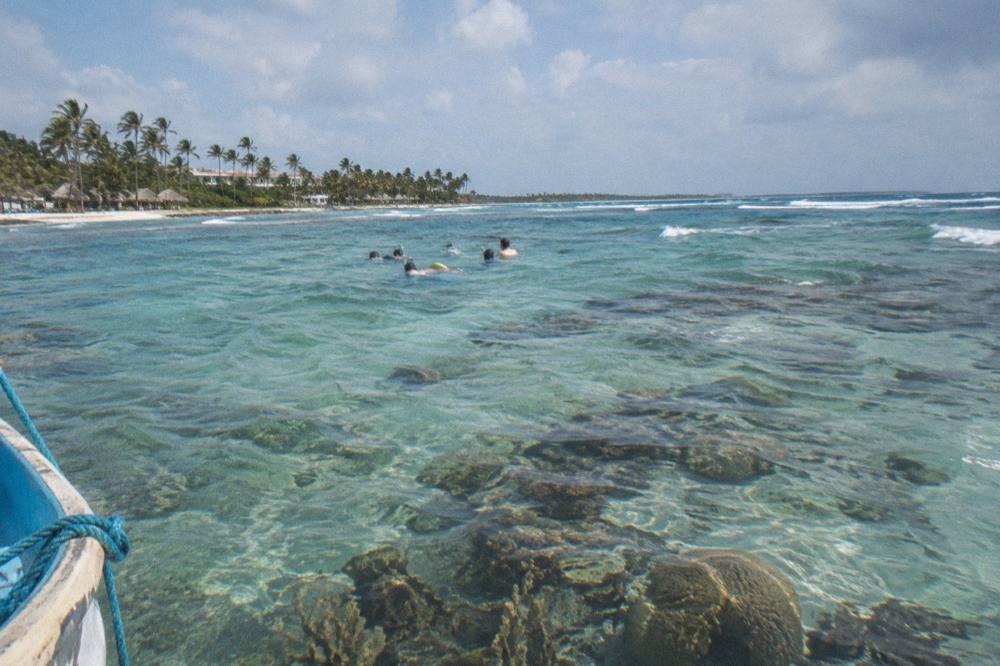
For travelers who care about snorkel visibility rather than the party, morning wins outright. Reefs near the Bavaro coast, reached by dozens of listings including the four-hour unlimited-drinks catamaran mentioned earlier, are at their clearest before afternoon wind chops the surface. Guests who care about dancing with a drink in hand get the better deal at sunset, when the light is flattering, the deck is warm and the ride home doubles as the night's first hour out.
The only genuinely time-sensitive category is the family or mixed-age sailing, and here the calendar matters more than the clock. Most party-format trips here set an 18-plus minimum or bill themselves adults-only, while the open-air catamaran from R & C Dreams Adventure, from $54 per person and 4.8 from 67 reviews, welcomes participants from age 4 with alcohol reserved for those over 18. In high season, those mixed-age boats fill with families; in shoulder season they run quieter, which suits couples. Budget expectations across all of these formats are laid out in the guide to Punta Cana party boat prices.
Is The Cheapest Month Also The Best Value Month?
Yes, in most cases. September and October bring the year's lowest demand while prices barely budge, so the same $49 to $89 shared boats sail with far fewer guests on board. The value trade is a higher rain total and the statistical peak of storm season, so the real question is whether your dates can absorb a possible reschedule.
This is where the pricing mechanics of boat tours work in the off-peak traveler's favor. Unlike hotels, whose rates swing dramatically with season, the shared boats below hold their published prices across the calendar, from $49 on the adults-only open-bar trip to $89 on the SeaPro cruise. What changes in the wet months is how many people share the deck. A catamaran listed at up to 100 or 120 guests that sails with 30 in October is, functionally, a different and better product at the same price.
The same logic applies to the multilingual Sunny Adventures party boat above, whose sandbar stop and open bar are simply more pleasant with deck space to spare. Private charters respond to low season differently: their per-boat prices, from $659 for the Blue Marine yacht celebration to $1,990 for the full-day Quetzal luxury catamaran to Saona or Catalina, are set by the operator, and low-season date availability is often easier to negotiate. The full private-versus-shared trade-off has its own page in the private catamaran versus shared party boat comparison.
The counter-argument for the high season is certainty, and it should not be dismissed. A February visitor is buying the highest probability of a dry, calm, postcard day, and paying for it with crowds and peak hotel rates. A October visitor is buying space and silence, and paying with a forecast to watch. Both end up on the same water.
With the calendar covered, three formats stand out for a timed booking: a sunset boat that works in every month, a sheltered Saona day for the weed-wary months, and an adults-only afternoon party for the high season. All three are bookable with free cancellation on their live listings.
Common Questions About Timing A Punta Cana Boat Trip
When Is The Best Time To Visit Punta Cana?
December through April is the driest, most reliable window, with March the driest month of all at about 53 mm of rain. Prices and crowds peak in the same stretch, so July and the November shoulder offer good weather-to-crowd trade-offs for flexible travelers.
Is Hurricane Season A Reason To Skip Punta Cana?
No. The season runs 1 June to 30 November, but direct strikes on the east coast are uncommon and the typical effect is one rescheduled boat day. Rarely. The weed piles on Atlantic-facing beaches like Bavaro and Macao, while boats sail to open-water reefs, sandbars and natural pools where it is largely absent. Saona trips cross to the more sheltered Caribbean side on top of that. October, averaging about 142 mm of rain, though it typically falls in short bursts rather than all-day rain. It is also among the emptiest months on the boats, which many travelers consider a fair trade. Yes. Shared boats from $49 per person, sunset cruises, Saona day trips and private charters all operate in every month, with the operator deciding day by day whether conditions are safe to sail. Morning for calm seas and the clearest snorkeling, late afternoon for the sunset slot that sails after the typical shower has passed. Midday departures belong mostly to full-day Saona itineraries.Will Sargassum Ruin A Summer Boat Trip?
What Is The Wettest Month In Punta Cana?
Do Party Boats Run All Year In Punta Cana?
What Time Of Day Is Best For A Boat Trip From Bavaro?